| Cover | Buddy holly crickets not fade away brunswick.jpg |
|---|---|
| Artist | the Crickets |
| Album | The "Chirping" Crickets |
| A-side | Oh, Boy! |
| Released | October 27, 1957 |
| Recorded | August 1957[1] |
| Studio | Norman Petty Recording Studios (Clovis, New Mexico)[2] |
| Genre | |
| Writer |
|
| Label | Brunswick[1] |
| Producer | Norman Petty[1][3] |
| Chronology | The Crickets singles |
| Prev year | 1957 |
| Next year | 1958 |
"Not Fade Away" is a 1957 song credited to Buddy Holly (originally under his first and middle names, Charles Hardin) and Norman Petty (although Petty's co-writing credit is likely to have been a formality[4]) and first recorded by Holly and his band, the Crickets.[3]
Original song
Holly and the Crickets recorded the song at the Norman Petty Recording Studios in Clovis, New Mexico, on May 27, 1957, the same day the song "Everyday" was recorded.[1] The rhythmic pattern of "Not Fade Away" is a variant of the Bo Diddley beat, with the second stress occurring on the second rather than third beat of the first measure, which was an update of the "hambone" rhythm, or patted juba from West Africa. Jerry Allison, the drummer for the Crickets, pounded out the beat on a cardboard box.[4] Allison, Holly's best friend, wrote some of the lyrics, though his name never appeared in the songwriting credits. Joe Mauldin played the double bass on this recording. It is likely that the backing vocalists were Holly, Allison, and Niki Sullivan, but this is not known for certain.[1]
"Not Fade Away" was originally released as the B-side of the hit single "Oh, Boy!" and was included on the album The "Chirping" Crickets (1957). The Crickets' recording never charted as a single.
Personnel
Buddy Holly and the Crickets
- Buddy Holly – lead vocals, lead guitar, backing vocals
- Jerry Allison – drums, card-box percussion
- Joe B. Mauldin – contrabass
- Niki Sullivan – rhythm guitar, backing vocals
The Rolling Stones version
| Cover | Not fade away.jpg |
|---|---|
| Artist | the Rolling Stones |
| B-side |
|
| Released |
|
| Recorded | January 10, 1964 |
| Studio | Olympic, London |
| Genre | |
| Label | |
| Writer |
|
| Producer | Andrew Loog Oldham |
| Chronology | Rolling Stones UK singles |
| Prev year | 1963 |
| Next year | 1964 |
The Rolling Stones' version of "Not Fade Away" was one of their first hits. Recorded in January 1964 and released by Decca Records on February 21, 1964, with "Little by Little" as the B-side, it was their first Top 10 hit in the United Kingdom, reaching number three.[5] London Records released the song in the US on March 6, 1964, as the band's first single there, with "I Wanna Be Your Man" as the B-side.[6] The single reached number 48 on the US Billboard Hot 100 singles chart.[7] It also reached number 44 on the Cash Box pop singles chart in the US and number 33 in Australia based on the Kent Music Report.[8] "Not Fade Away" was not on the UK version of their debut album, The Rolling Stones, but was the opening track of the US version, released a month later as England's Newest Hit Makers. It can also be found on the UK version of their 1966 compilation album Big Hits (High Tide and Green Grass). Cash Box described it as "a wild, freewheeling full-sounding pounder that can take off in no time flat".[9] It was a mainstay of the band's concerts in their early years, usually opening the shows. It was revived as the opening song in the band's Voodoo Lounge Tour, in 1994 and 1995.
Personnel
According to authors Philippe Margotin and Jean-Michel Guesdon,[10] except where noted:
- Mick Jagger – double tracked lead vocal, hand claps, tambourine, maracas[note 1]
- Keith Richards – twelve-string acoustic guitar, lead guitar
- Brian Jones – harmonica
- Bill Wyman – bass
- Charlie Watts – drums
Charts
| Chart (1964) | Peak position |
|---|---|
| Australia (Kent Music Report)[8] | 33 |
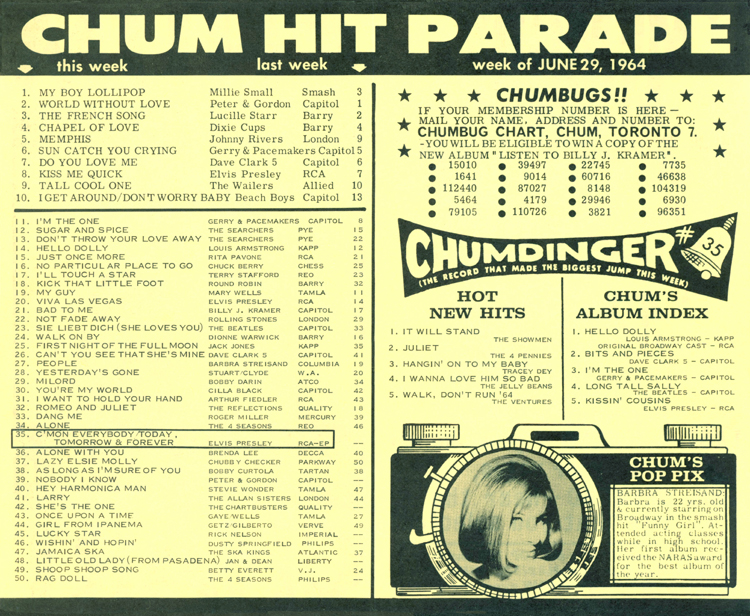
| Canada (CHUM Chart)[11] | 22 |
| Sweden (Kvällstoppen)[12] | 17 |
| US Cash Box Top 100[13] | 44 |
| US Record World Top 100[14] | 58 |
Other cover versions
- The song is closely associated with the Grateful Dead as one of their signature tunes—one which the band transformed from Holly's 1950s boy/girl romanticism to one reflecting the 1960s' more spiritual universal love. Their 1971 recording of the song is included on their eponymous second live album. Another version of the song is included on Rare Cuts and Oddities 1966 (2005). The Dead first performed it live on February 19, 1969, at the Carousel Ballroom, San Francisco, California, and subsequently performed it more than 600 more times before the group disbanded in 1995, following the death of lead guitarist Jerry Garcia. The surviving members (except Tom Constanten and Donna Jean Godchaux) reunited and played the song for the last time all together as the last song of the second set (VC before the encores) on the last night of Fare Thee Well: Celebrating 50 Years of the Grateful Dead.[15] The song continued to be played by later iterations of the band, including the Other Ones, the Dead, and most recently Dead & Company.[16]
- Bobby Fuller released a recording in 1962 as a 45 single on Eastwood Records.[17]
- The Everly Brothers recorded the song on their 1972 album Pass the Chicken & Listen.
- Black Oak Arkansas as Black Oak released the song on their 1977 album Race With the Devil.[18]
- Rush recorded a version of "Not Fade Away" as their debut single in 1973, which peaked at number 88 in Canada.[citation needed] The single was released on the band's own Moon Records label, and is considered a rare collector's item. "Not Fade Away" and the B-side "You Can't Fight It" were reissued on the 2025 compilation album Rush 50.
- Stephen Stills released a version on his 1978 album Thoroughfare Gap.
- Tanya Tucker included a funky, rock-and-roll version of "Not Fade Away" on her album, TNT (1978). Tucker's cover of this song peaked at number 70 on the US Billboard pop singles chart in 1979.[19]
- Florence and the Machine recorded a version of the song in 2010.[20]
- Former Beatles drummer Pete Best released a version on the 1999 album Casbah Coffee Club.[21]
- Stevie Nicks contributed a cover of "Not Fade Away" for the tribute album Listen to Me: Buddy Holly released in September 2011.
- John Scofield covered the song on his eponymous 2022 solo album.[22]
- The Byrds also performed this cover during their act on the show Shindig! in 1965.[23]
Explanatory notes
- ^ In a July 1964 issue of Rolling Stones Monthly, the Stones' manager and producer Andrew Loog Oldham stated that American producer Phil Spector played maracas on the track.[24] Wyman later disputed this account, suggesting Oldham created the story to increase the song's publicity.[25] While Spector was present at some of the band's sessions, including on 28 January and 4 February 1964,[26] they recorded "Not Fade Away" on 10 January 1964.[26][27] Both Margotin & Guesdon and authors Andy Babiuk & Greg Prevost write Jagger contributed maracas.[26][27]
References
- ^ Buddy Holly: Greatest Hits. Liner notes. 1995. MCA Records.
- ^ Vnuk, Paul (September 2025). "Norman Petty Recording Studios". Recording. pp. 22–31.
- ^
- ^ The Real Buddy Holly Story (DVD). White Star Studios. 1987.
- ^ "Gloucestershire - People - Brian Jones (1942-1969)". BBC. Retrieved 2016-08-29.
- ^ Babiuk & Prevost 2013, p. 101.
- ^ Carr, Roy (1976). The Rolling Stones, an Illustrated Record. London: New English Library.
- ^ Kent, David. (2005). Australian chart book (1940-1969). Turramurra, N.S.W.: Australian Chart Book. ISBN 0-646-44439-5. OCLC 62561852
- ^ "CashBox Record Reviews". Cash Box. April 4, 1964. p. 16. Retrieved 2022-01-12.[dead link]
- ^ Margotin & Guesdon 2016, pp. 50–51.
- ^ "CHUM Hit Parade - June 29, 1964"
- ^ Hallberg, Eric (1993). Eric Hallberg presenterar Kvällstoppen i P 3: Sveriges radios topplista över veckans 20 mest sålda skivor 10. 7. 1962 - 19. 8. 1975. Drift Musik. ISBN 9163021404.
- ^ "Cash Box Top 100 7/04/64". Tropicalglen.com. Retrieved 27 April 2021.
- ^ "100 Top Pops - Record World". Record World. July 11, 1964.
- ^ Guarino, Mark (6 July 2015). "'Grateful Dead: final concerts unite fans and band as legends fade away". The Guardian. Retrieved September 23, 2019.
- ^ "Dead & Company > Tour Statistics". setlist.fm. Retrieved September 23, 2019.
- ^ Not Fade Away. Bobby Fuller. Discogs. Retrieved 30 June 2025.
- ^ Not Fade Away. Black Oak. 1977. Discogs. Retrieved 30 June 2025.
- ^ "Tanya Tucker - Not Fade Away". 45cat.com. Retrieved 27 April 2021.
- ^ "The Life of a Song: 'Not Fade Away'". Financial Times. 5 December 2016.
- ^ "Not Fade Away" by The Pete Best Band. Second Hand Songs. Retrieved 8 August 2025.
- ^ Jurek, Thom (2022). "John Scofield: John Scofield". AllMusic. Retrieved 6 July 2022.
- ^ "The Byrds - "Not Fade Away" - Shindig! 1965". YouTube.com. 20 February 2016.
- ^ Babiuk & Prevost 2013, pp. 96, 652.
- ^ Wyman & Havers 2002, p. 99, quoted in Babiuk & Prevost 2013, p. 96.
- ^ Margotin & Guesdon 2016, p. 51.
- ^ Babiuk & Prevost 2013, p. 96.
Sources
- Babiuk, Andy & Prevost, Greg (2013). Rolling Stones Gear: All the Stones' Instruments from Stage to Studio. Milwaukee: Backbeat Books. ISBN 978-1-61713-092-2.
- Margotin, Philippe & Guesdon, Jean-Michel (2016). The Rolling Stones All the Songs: The Story Behind Every Track. New York: Black Dog & Leventhal Publishers. ISBN 978-0-316-31774-0.
- Wyman, Bill & Havers, Richard (2002). Rolling with the Stones. New York: DK. ISBN 978-0-7894-9998-1.