HD 219134 (also known as Gliese 892 or HR 8832) is a main-sequence star in the constellation of Cassiopeia. It is smaller and less luminous than the Sun, with a spectral class of K3V, which makes it an orange-hued star. HD 219134 is relatively close to our system, with an estimated distance of 21.34 light years. This star is close to the limit of apparent magnitude that can still be seen by the unaided eye. The limit is considered to be magnitude 6 for most observers.
Host star
HD 219134 is a main sequence star with a spectral classification of K3V.[1] It has a mass and radius about three quarters that of the Sun, is somewhat cooler than the Sun at 4,817 K, and only 27% of its luminosity.[2]
This star has a magnitude 9.4 optical companion.[3] The high proper motion of HD 219134 means that the separation of the companion changed from 102.3 " in 1852 to 271.6 " in 2002.[4] The companion is a subgiant over fifty times further away than HD 219134.[5]
Planetary system
HD 219134 has a system of at least five known exoplanets. The innermost planet, HD 219134 b, is a rocky super-Earth based on size (1.6 Earth radii), and density (6.4 grams per cubic cm).[6][7] This and three additional exoplanets; one super-Earth (designated c and later found to be rocky as well), one Neptunian world (d), and one Jovian world (e); were deduced using HARPS-N radial velocity data by Motalebi et al. in 2015.[8][9] Two months later, Vogt et al. published a paper on this system which found a 6-planet solution, with planets b, c & d corresponding to those in Motalebi et al., f & g being new planets, and h corresponding to Motalebi's e but with different, and more accurate, estimated parameters.[10][11]
A number of independent studies have been done regarding the planetary system of HD 219134, with some of their results conflicting with each other. As of March 2017, the star is known to have at least 5 planets, with two of them (HD 219134 b and c) known to be transiting, rocky super-Earths.[12][13] While a 2016 study suggested that the radial velocity signal corresponding to planet f might be caused by stellar activity,[11] it has been confirmed by subsequent studies in 2017[12] and 2021.[14] Planet g, with a 94-day period, has not been detected by subsequent studies, but some studies have found evidence of a 192-day signal which may be the true period of planet g. However, the planetary nature of this signal is unconfirmed.[15][16]
Habitable zone
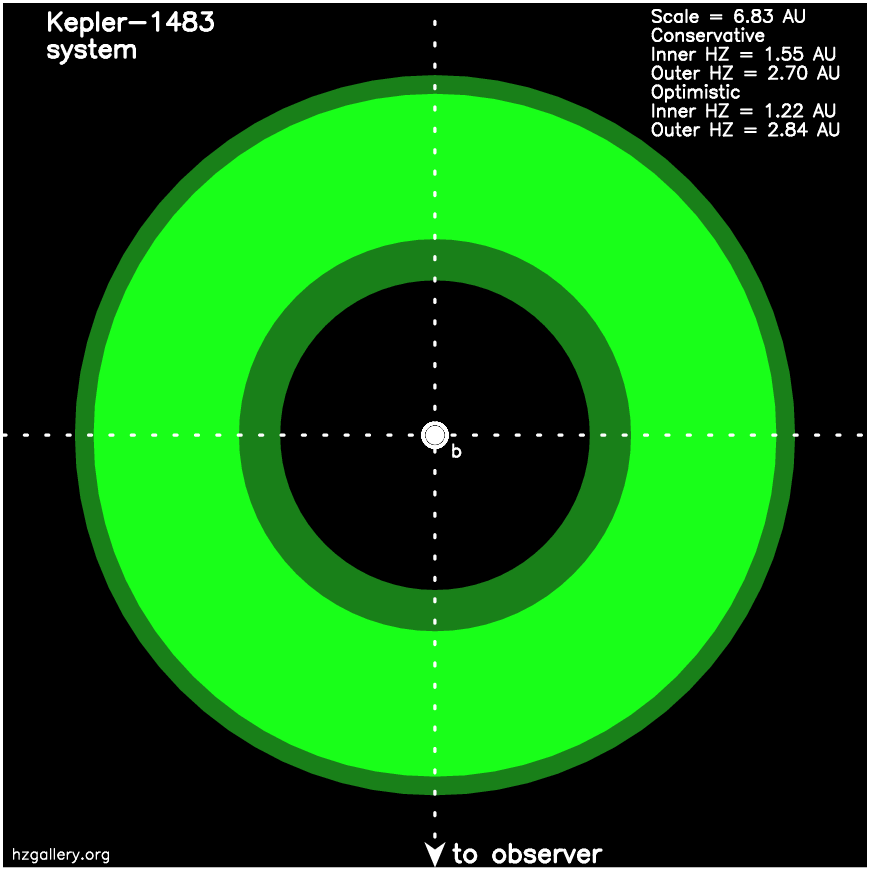
The conservative habitable zone (CHZ) of HD 219134 is estimated to extend from 0.516 to 0.948 AU.[17][18] As of 2024, none of the planets orbiting the star are confirmed to orbit inside the habitable zone.[1] The planet candidate HD 219134 g may orbit slightly interior to the inner edge of the habitable zone based on its initially published parameters,[10] or may orbit within the habitable zone based on a more recent estimated orbital period of 192 days and semi-major axis of 0.603 AU. [15] This planet is significantly more massive than Earth and therefore it likely retains a dense atmosphere, comparable to the Solar System's ice giants (see Mini-Neptune).
See also
References
- ^ Dietrich, Jeremy; Apai, Dániel; Malhotra, Renu (2022). "An Integrative Analysis of the HD 219134 Planetary System and the Inner solar system: Extending DYNAMITE with Enhanced Orbital Dynamical Stability Criteria". The Astronomical Journal. 163 (2): 88. arXiv:2112.05337. Bibcode:2022AJ....163...88D. doi:10.3847/1538-3881/ac4166. S2CID 245117944
- ^ Li, Yaguang; Huber, Daniel; Ong, J. M. Joel; van Saders, Jennifer; Costa, R. R.; Reersted Larsen, Jens; Basu, Sarbani; Bedding, Timothy R.; Dai, Fei; Chontos, Ashley; Carmichael, Theron W.; Hey, Daniel; Kjeldsen, Hans; Hon, Marc; Campante, Tiago L. (2025-02-03). "K Dwarf Radius Inflation and a 10 Gyr Spin-down Clock Unveiled through Asteroseismology of HD 219134 from the Keck Planet Finder". The Astrophysical Journal. 984 (2): 125. arXiv:2502.00971. Bibcode:2025ApJ...984..125L. doi:10.3847/1538-4357/adc737. ISSN 0004-637X
- ^ Eggleton, P. P. & Tokovinin, A. A. (September 2008). "A catalogue of multiplicity among bright stellar systems". Monthly Notices of the Royal Astronomical Society. 389 (2): 869–879. arXiv:0806.2878. Bibcode:2008MNRAS.389..869E. doi:10.1111/j.1365-2966.2008.13596.x. S2CID 14878976
- ^ Mason, Brian D.; Wycoff, Gary L.; Hartkopf, William I.; Douglass, Geoffrey G.; Worley, Charles E. (2001). "The 2001 US Naval Observatory Double Star CD-ROM. I. The Washington Double Star Catalog". The Astronomical Journal. 122 (6): 3466. Bibcode:2001AJ....122.3466M. doi:10.1086/323920
- ^
- ^ "PIA19832: Location of Nearest Rocky Exoplanet Known". NASA. 30 July 2015. Retrieved 30 July 2015.
- ^ Chou, Felicia & Clavin, Whitney (30 July 2015). "NASA's Spitzer Confirms Closest Rocky Exoplanet". NASA. Retrieved 31 July 2015.
- ^ Motalebi, F. et al. (December 2015). "The HARPS-N Rocky Planet Search. I. HD 219134 b: A transiting rocky planet in a multi-planet system at 6.5 pc from the Sun". Astronomy & Astrophysics. 584: A72. arXiv:1507.08532. Bibcode:2015A&A...584A..72M. doi:10.1051/0004-6361/201526822. S2CID 45652878
- ^ "Cassiopeia's Hidden Gem". Harvard. 30 July 2015. Retrieved 30 July 2015.
- ^ Vogt, Steven S. et al. (November 2015). "Six Planets Orbiting HD 219134". The Astrophysical Journal. 814 (1): 12. arXiv:1509.07912. Bibcode:2015ApJ...814...12V. doi:10.1088/0004-637X/814/1/12. S2CID 45438051
- ^ Johnson, Marshall C. et al. (April 2016). "A 12-year Activity Cycle for the Nearby Planet Host Star HD 219134". The Astrophysical Journal. 821 (2): 74. arXiv:1602.05200. Bibcode:2016ApJ...821...74J. doi:10.3847/0004-637X/821/2/74. S2CID 118651905
- ^ Gillon, Michaël et al. (2017). "Two massive rocky planets transiting a K-dwarf 6.5 parsecs away". Nature Astronomy. 1 (3): 0056. arXiv:1703.01430. Bibcode:2017NatAs...1E..56G. doi:10.1038/s41550-017-0056. S2CID 56075932
- ^ "Back Alley Astronomy: HD 219134 Scorecard: 5 planets, 2 transiting". 18 April 2017.
- ^ Rosenthal, Lee J. et al. (2021). "The California Legacy Survey. I. A Catalog of 178 Planets from Precision Radial Velocity Monitoring of 719 Nearby Stars over Three Decades". The Astrophysical Journal Supplement Series. 255 (1): 8. arXiv:2105.11583. Bibcode:2021ApJS..255....8R. doi:10.3847/1538-4365/abe23c. S2CID 235186973
- ^ Hirsch, Lea A. et al. (2021). "Understanding the Impacts of Stellar Companions on Planet Formation and Evolution: A Survey of Stellar and Planetary Companions within 25 pc". The Astronomical Journal. 161 (3): 134. arXiv:2012.09190. Bibcode:2021AJ....161..134H. doi:10.3847/1538-3881/abd639. S2CID 229297873
- ^ Harada, Caleb K. & Dressing, Courtney D. et al. (September 2025). "SPORES-HWO. II. Companion Mass Limits and Updated Planet Properties for 120 Future Exoplanet Imaging Targets from 35 Years of Precise Doppler Monitoring". The Astronomical Journal. arXiv:2409.10679
- ^ "HD 219134 g". ExoKyoto
- ^ "HD 219134". hzgallery.org
External links
- "BD+56 2966 / HR 8832". SolStation. Archived from the original on April 17, 2002. Retrieved November 7, 2005.