The climate of Africa is a range of climates such as the equatorial climate, the tropical wet and dry climate, the tropical monsoon climate, the semi-arid climate (semi-desert and steppe), the desert climate (hyper-arid and arid), the humid subtropical climate, and the subtropical highland climate. Temperate climates are rare across the continent except at very high elevations and along the fringes. In fact, the climate of Africa is more variable by rainfall amount than by temperatures, which are consistently high. African deserts are the sunniest and the driest parts of the continent, owing to the prevailing presence of the subtropical ridge with subsiding, hot, dry air masses. Africa holds many heat-related records: the continent has the hottest extended region year-round, the areas with the hottest summer climate, the highest sunshine duration, and more.
Owing to Africa's position across equatorial and subtropical latitudes in both the northern and southern hemisphere, several different climate types can be found within it. The continent mainly lies within the intertropical zone between the Tropic of Cancer and the Tropic of Capricorn, hence its interesting density of humidity. Precipitation intensity is always high, and it is a hot continent. Warm and hot climates prevail all over Africa, but mostly the northern part is marked by aridity and high temperatures. Only the northernmost and the southernmost fringes of the continent have a Mediterranean climate. The equator runs through the middle of Africa, as do the Tropic of Cancer and the Tropic of Capricorn, making Africa the most tropical continent.
Temperatures
Globally, heating of the earth near the equator leads to large amounts of upward motion and convection along the monsoon trough or Intertropical Convergence Zone. The divergence over the near-equatorial trough leads to air rising and moving away from the equator aloft. As it moves towards the Mid-Latitudes, the air cools and sinks, which leads to subsidence near the 30th parallel of both hemispheres. This circulation is known as the Hadley cell and leads to the formation of the subtropical ridge.[1] Many of the world's deserts are caused by these climatological high-pressure areas,[2] including the Sahara Desert.
Temperatures are hottest within the Sahara regions of Algeria and Mali,[3] and coolest across the south and at elevation within the topography across the eastern and northwest sections of the continent. The hottest average temperature on Earth is at Dallol, Ethiopia, which averages a temperature of 33.9 °C (93.0 °F) throughout the year.[4] The hottest temperature recorded within Africa, which was also the world record, was 57.8 °C (136.0 °F) at 'Aziziya, Libya, on 13 September 1922. This was later proven to be false, being derived from an inaccurate reading of a thermometer. The world's hottest place is in fact Death Valley, in California.[5][6][7] Apparent temperatures, combining the effect of the temperature and humidity, along the Red Sea coast of Eritrea and Gulf of Aden coast of Somalia range between 57 °C (135 °F) and 63 °C (145 °F) during the afternoon hours.[3] The lowest temperature measured within Africa was −24 °C (−11 °F) at Ifrane, Morocco, on 11 February 1935.[8] Nevertheless, the major part of Africa experiences extreme heat during much of the year, especially the deserts, semi-deserts, steppes and savannas. The African deserts are arguably the hottest places on Earth, especially the Sahara Desert and the Danakil Desert, located in the Horn of Africa.
Wind
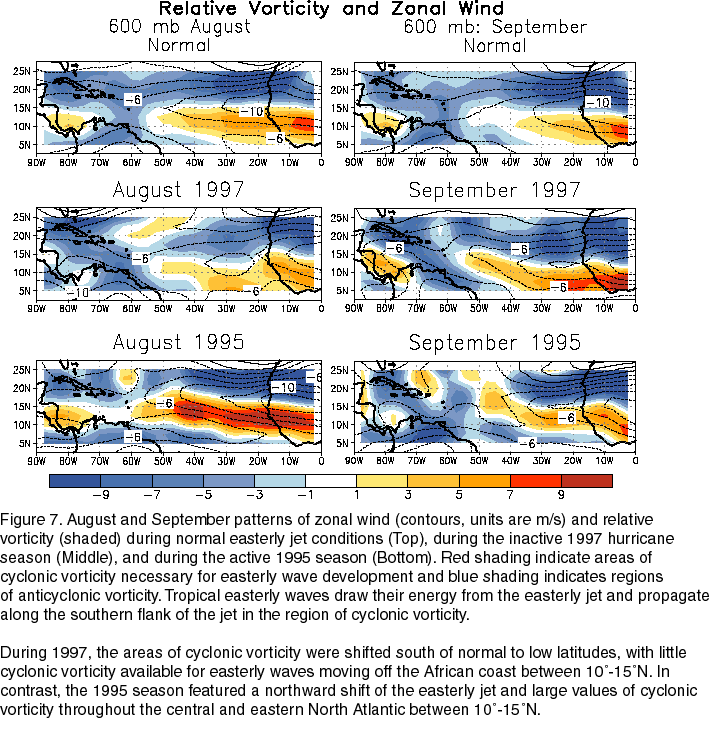
The mid-level African easterly jet stream north of the equator is considered to play a crucial role in the West African monsoon,[9] and helps form the tropical waves which march across the tropical Atlantic and the eastern part of the Pacific during the warm season.[10] The jet exhibits both barotropic and baroclinic instability, which produces synoptic-scale, westward-propagating disturbances in the jet known as African easterly waves, or tropical waves. A small number of mesoscale storm systems embedded in these waves develop into tropical cyclones after they move from west Africa into the tropical Atlantic, mainly during August and September. When the jet lies south of normal during the peak months of the Atlantic hurricane season, tropical cyclone formation is suppressed.[11]
Low-level jets are fast winds which form close to the surface (within 1.5 km). They affect a number of climate processes across Africa. The Somali Low-level Jet,[12] which forms of the coast of East Africa, contributes to the existence of the Somali Desert.[13][14] Low-level jets of the Sahara are known to be important for raising dust off the dry desert surface. For example, the low-level jet over Chad,[15] is the driver of dust emission from the Bodélé Depression, the largest source of atmospheric dust on the planet.[16] Easterly low-level jets, such as Turkana jet, which form in river valleys across the East African Rift System supply millions of tonnes of water vapour originating from the Indian Ocean across East Africa to the inner part of the continent, including the Congo rainforest.[17] In doing so, they leave East Africa unusually dry for its latitude.[18] Low-level southwesterlies emanating from the Gulf of Guinea are the key moisture source for the West African monsoon in northern hemisphere summer.[19]
The Tropical Easterly Jet, which forms high up in the atmosphere, 15–17 km above the surface, is another important factor. Variations to the speed and position of this jet stream can affect rainfall in the Congo Basin and the Sahel.[20]
Precipitation
Great parts of North Africa and Southern Africa as well as the whole Horn of Africa mainly have a hot desert climate, or a hot semi-arid climate for the wetter locations. The Sahara Desert in North Africa is the largest hot desert in the world and is one of the hottest, driest and sunniest places on Earth. Located just south of the Sahara is a narrow semi-desert steppe (a semi-arid region) called the Sahel, while Africa's most southern areas contain both savanna plains, and its central portion, including the Congo Basin, contains very dense jungle (rainforest) regions. The western equatorial region is the wettest portion of the continent. Annually, the rain belt across the continent moves northward into Sub-Saharan Africa by August, then passes back southward into south-central Africa by March.[21] Areas with a savannah climate in Sub-Saharan Africa, such as Ghana, Burkina Faso,[22][23] Darfur,[24] Eritrea,[25] Ethiopia,[26] and Botswana have a distinct rainy season.[27] El Nino results in drier-than-normal conditions in Southern Africa from December to February, and wetter-than-normal conditions in equatorial East Africa over the same period.[28]
In Madagascar, trade winds bring moisture up the eastern slopes of the island, which is deposited as rainfall, and bring drier downsloped winds to areas south and west, leaving the western sections of the island in a rain shadow. This leads to significantly more rainfall over northeast sections of Madagascar than its southwestern portions.[29] Southern Africa receives most of its rainfall from summer convective storms, tropical lows, mesoscale convective systems. Extratropical cyclones moving through the Westerlies, can also bring significant winter rainfall. Once a decade, tropical cyclones lead to excessive rainfall across the region.[30]
Snow and glaciers
Snow is an almost annual occurrence on some of the mountains of South Africa, including those of the Cedarberg and around Ceres in the South-Western Cape, and on the Drakensberg in Natal and Lesotho. Tiffendell Resort, in the Drakensberg, is the only commercial ski resort in South Africa, and has "advanced snow-making capability" allowing skiing for three months of the year.[31] The Mountain Club of South Africa (MCSA) and the Mountain and Ski Club (MSC)[32] of the University of Cape Town both have equipped ski huts in the Hex River mountains. Skiing including snowboarding in the Cape is a hit-and-miss affair, both in terms of timing of snowfalls, and whether there is sufficient snow to cover the rocks.
Table Mountain gets a light dusting of snow on the Front Table and also at Devil's Peak every few years. Snowfalls on Table Mountain took place on 20 September 2013;[33] 30 August 2013;[34] 5 August 2011;[35] and on 15 June 2010.[36]
Snow is a rare occurrence in Johannesburg; it fell in May 1956, August 1962, June 1964, September 1981, August 2006, and on 27 June 2007,[37] accumulating up to 10 centimetres (3.9 in) in the southern suburbs.
Additionally, snow regularly falls in the Atlas Mountains in the Maghreb, as well as the Mediterranean regions and Sinai peninsula of Egypt. Snowfall is also a regular occurrence at Mount Kenya and Mount Kilimanjaro in Tanzania.
There have been permanent glaciers on the Rwenzori Mountains, on the border of Uganda and the Democratic Republic of the Congo. However, by the 2010s, the glaciers were in retreat, and they are under threat of disappearing through rising temperatures.[38]
Climate change
In chapter 9 of the IPCC Sixth Assessment Report, it is reported that although greenhouse gas emissions are among the lowest in Africa, anthropogenic climate change has severely threatened daily life. People experience extreme food insecurity, high mortality rates, major biodiversity loss, and more as a result of global warming. Additionally, because of reduced economic activity and growth and inequities in funding, the ability for adaptation to these conditions is also reduced.[39]
Severe weather
Tornadoes
Tornadoes can occur regularly in South Africa along the eastern coast with the Indian Ocean.[40]
Tropical cyclones
Powerful tropical cyclones regularly affect southeastern Africa. On average, 1.5 tropical cyclones strike Madagascar each year, which is the most affected area in Africa.[41] In March 1927, a tropical cyclone struck eastern Madagascar, killing at least 500 people.[42] In March 2004, Cyclone Gafilo hit northeastern Madagascar as one of the island's strongest ever cyclones, killing 363 people, leaving US$250 million in damage.[43] In March 2019, Cyclone Idai hit central Mozambique and killed 1,302 people across Southern Africa, – affecting more than 3 million people. Total damages from Idai across Mozambique, Zimbabwe, Madagascar, and Malawi were estimated to be at least $2.2 billion (2019 USD).[44][45] Roughly one month later, Cyclone Kenneth struck northern Mozambique as the country's strongest ever landfall.[46] In 2020, Cyclone Freddy struck Mozambique in two different locations, producing widespread rainfall that killed 1,434 people along its path, mostly in Malawi.[47][48]
Occasionally, cyclones in the Mediterranean can affect northern Africa, and which also have characteristics of a tropical cyclone. In September 2023, Storm Daniel moved ashore Libya and produced heavy rainfall, producing flash flooding after two dams failed. The storm killed at least 4,333 people in the country, becoming the deadliest storm to hit Africa in recorded history.[49][50] In September 1969, a cyclone in the Mediterranean Sea killed nearly 600 people in Tunisia and Libya.[51] Cyclones from the Indian Ocean can strike the Horn of Africa. In November 2013, a deep depression struck Somalia and killed 162 people while also causing extensive livestock damage.[52][53][54] The temperature contrast between the hot Sahara Desert in northern Africa and the cooler Gulf of Guinea to the south produces the African easterly jet, which generates tropical waves, or an elongated area of low pressure. These waves are often the formation source of Atlantic and Pacific hurricanes.[55]
Weather forecasting infrastructure
Africa's weather forecasting infrastructure is significantly underdeveloped, affecting its ability to manage severe weather events. With a population of approximately 1.2 billion, Africa only has 37 weather radar stations, in stark contrast to the 636 stations in the United States and European Union. This scarcity of weather stations and early warning systems leads to inadequate disaster preparedness and response, compounded by maintenance issues with many existing radar systems. The lack of proper infrastructure results in high fatality rates and extensive damage during disasters. For instance, in 2023, severe flooding and landslides around Lake Kivu resulted in at least 600 deaths, and Cyclone Idai in East Africa caused over 1,000 deaths due to insufficient early warnings. These incidents underscore the urgency of investing in early warning systems, which can significantly reduce damage and save lives. The World Meteorological Organization suggests that an $800 million investment in developing countries could prevent annual losses of $3 to $16 billion.[56]
See also
References
- ^ Thompson, Owen E. (1996). "Hadley Circulation Cell". Archived 5 March 2009 at the Wayback Machine Channel Video Productions. Retrieved 11 February 2007.
- ^ ThinkQuest team 26634 (1999). "The Formation of Deserts". Archived 17 October 2012 at the Wayback Machine Oracle ThinkQuest Education Foundation. Retrieved 16 February 2009.
- ^ Burt, Christopher C. (2004). Extreme Weather: a guide & record book. W. W. Norton & Company, Inc. pp. 24–28. ISBN 978-0-393-32658-1.
- ^ Wagner, Ronald L. & Bill Adler, Jr. (1997). The Weather Sourcebook. Adler & Robin Books, Inc. p. 91. ISBN 978-0-76270-080-6.
- ^ "NCDC: Global Measured Extremes of Temperature and Precipitation". Archived from the original on 2007-06-22.
- ^ El Fadli, K. I. et al. (September 2012). "World Meteorological Organization Assessment of the Purported World Record 58°C Temperature Extreme at El Azizia, Libya (13 September 1922)". Bulletin of the American Meteorological Society. 94 (2): 199–204. Bibcode:2013BAMS...94..199E. doi:10.1175/BAMS-D-12-00093.1 (The 136 °F (57.8 °C), claimed by 'Aziziya, Libya, on 13 September 1922, has been officially deemed invalid by the World Meteorological Organization.)
- ^ "World Meteorological Organization World Weather / Climate Extremes Archive". Archived from the original on 4 January 2013. Retrieved 10 January 2013.
- ^ "Global Measured Extremes of Temperature and Precipitation". National Climatic Data Center. Retrieved 21 June 2007.
- ^ Cook, Kerry H. (1999). "Generation of the African Easterly Jet and Its Role in Determining West African Precipitation". Journal of Climate. 12 (5): 1165. Bibcode:1999JCli...12.1165C. doi:10.1175/1520-0442(1999)012<1165:GOTAEJ>2.0.CO;2. ISSN 1520-0442
- ^ Landsea, Chris. AOML Frequently Asked Questions. "Subject: A4) What is an easterly wave?" Retrieved 8 May 2008.
- ^ Climate Prediction Center (November 1997). "Figure 7". National Oceanic and Atmospheric Administration. Retrieved 2011-02-05.
- ^ Findlater, J. (1969). "A major low-level air current near the Indian Ocean during the northern summer". Quarterly Journal of the Royal Meteorological Society. 95 (404): 362–380. Bibcode:1969QJRMS..95..362F. doi:10.1002/qj.49709540409
- ^ Cane, Mark A.; Seager, Richard; Yang, Wenchang; Lyon, Bradfield (2015). "The Annual Cycle of East African Precipitation". Journal of Climate. 28 (6): 2385–2404. Bibcode:2015JCli...28.2385Y. doi:10.1175/JCLI-D-14-00484.1
- ^ Nicholson, S. E., 2011: Dryland Climatology. Cambridge University Press, 528 pp.
- ^ Washington, Richard & Todd, Martin C. (2005). "Atmospheric controls on mineral dust emission from the Bodélé Depression, Chad: The role of the low level jet". Geophysical Research Letters. 32 (17). Bibcode:2005GeoRL..3217701W. doi:10.1029/2005GL023597
- ^ Bristow, Charlie S.; Drake, Nick; Armitage, Simon (2009). "Deflation in the dustiest place on Earth: The Bodélé Depression, Chad". Geomorphology. 105 (1): 50. Bibcode:2009Geomo.105...50B. doi:10.1016/j.geomorph.2007.12.014
- ^ Munday, Callum; Engelstaedter, Sebastian; Ouma, Gilbert; Ogutu, Geoffrey; Olago, Daniel; Ong'Ech, Dennis; Lees, Thomas; Wanguba, Bonface; Nkatha, Rose; Ogolla, Clinton; Gàlgalo, Roba Ali; Dokata, Abdi Jillo; Kirui, Erick; Hope, Robert; Washington, Richard (2022). "Observations of the Turkana Jet and the East African Dry Tropics: The RIFTJet Field Campaign". Bulletin of the American Meteorological Society. 103 (8): E1828–E1842. Bibcode:2022BAMS..103E1828M. doi:10.1175/BAMS-D-21-0214.1
- ^ Munday, Callum; Savage, Nicholas; Jones, Richard G.; Washington, Richard (2023). "Valley formation aridifies East Africa and elevates Congo Basin rainfall". Nature. 615 (7951): 276–279. Bibcode:2023Natur.615..276M. doi:10.1038/s41586-022-05662-5
- ^ Thorncroft, Chris D.; Nguyen, Hanh; Zhang, Chidong; Peyrillé, Philippe (2011). "Annual cycle of the West African monsoon: Regional circulations and associated water vapour transport". Quarterly Journal of the Royal Meteorological Society. 137 (654): 129–147. Bibcode:2011QJRMS.137..129T. doi:10.1002/qj.728
- ^ Nicholson, Sharon E. & Klotter, Douglas (2021). "The Tropical Easterly Jet over Africa, its representation in six reanalysis products, and its association with Sahel rainfall". International Journal of Climatology. 41 (1): 328–347. Bibcode:2021IJCli..41..328N. doi:10.1002/joc.6623
- ^ Mitchell, Todd (October 2001). "Africa Rainfall Climatology". University of Washington. Archived from the original on 2014-09-04. Retrieved 2010-01-02.
- ^ Laux, Patrick et al. (2008). "Predicting the regional onset of the rainy season in West Africa". International Journal of Climatology. 28 (3): 329–342. Bibcode:2008IJCli..28..329L. doi:10.1002/joc.1542. S2CID 129309284
- ^ Laux, Patrick et al. (2009). "Modelling daily precipitation features in the Volta Basin of West Africa". International Journal of Climatology. 29 (7): 937–954. Bibcode:2009IJCli..29..937L. doi:10.1002/joc.1852. S2CID 129107711
- ^ Vandervort, David (2009). "Darfur: getting ready for the rainy season". International Committee of the Red Cross. Retrieved 6 February 2009.
- ^ Mebrhatu, Mehari Tesfazgi; M. Tsubo, and Sue Walker (2004). "A Statistical Model for Seasonal Rainfall Forecasting over the Highlands of Eritrea". New directions for a diverse planet: Proceedings of the 4th International Crop Science Congress. Retrieved 8 February 2009.
- ^ Alex Wynter (2009). Ethiopia: March rainy season "critical" for southern pastoralists. Thomson Reuters Foundation. Retrieved on 6 February 2009.
- ^ The Voice (2009). "Botswana: Rainy Season Fills Up Dams". allAfrica.com. Retrieved 6 February 2009.
- ^ "La Niña Weather Likely to Last for Months | Scoop News"
- ^ Arivelo, T. Andry; A. Ratiarison; M. Bessafi; Rodolphe Ramiharijafy (19 December 2007). "Madagascar rainfall climatology: Extreme Phenomena". Stanford University. Retrieved 2010-01-02.
- ^ Mngadi, Pearl; Petrus J. M. Visser; Elizabeth Ebert (October 2006). "Southern Africa Satellite Derived Rainfall Estimates Validation". International Precipitation Working Group. p. 1. Retrieved 2010-01-05.[dead link]
- ^ "Skiing and Snowboarding". Tiffendell. Retrieved 16 February 2014.
- ^ "UCT Mountain and Ski Club". Archived from the original on 3 June 2019. Retrieved 16 February 2014.
- ^ "Snow on Table Mountain". 20 September 2013. Archived from the original on 30 June 2019. Retrieved 16 February 2014.
- ^ "Snow Doubt…There's Snow on Table Mountain Today". 30 August 2013. Retrieved 16 February 2014.
- ^ "Snow on Table Mountain: August Chill Sets In". Archived from the original on 4 June 2021. Retrieved 16 February 2014.
- ^ "Icy Weather Brings Snow to Table Mountain". Retrieved 16 February 2014.
- ^ SABCnews.com. "Joburg covered by snow as temperature drops". Archived from the original on 2007-06-29. Retrieved 2007-07-16.
- ^ Carrington, Dalsy (2014). "Last chance to see: Disappearing glaciers in the 'Mountains of the Moon'". 3 April 2014 CNN.
- ^ Trisos, Christopher H. "Chapter 9: Africa". IPCC Sixth Assessment Report
- ^ Godwell Nhamo, Lazarus Chapungu (ed.) (2021). The Increasing Risk of Floods and Tornadoes in Southern Africa. Springer Nature. ISBN 978-3-030-74192-1. ISSN 2523-3084
- ^ "Madagascar". United Nations Office for the Coordination of Humanitarian Affairs. 15 February 2018. Archived 11 April 2021 at the Wayback Machine. Retrieved April 11, 2021.
- ^ "08 Mar 1927 - MADAGASCAR CYCLONE. - Trove". Argus. 8 March 1927. Archived 2020-05-29 at the Wayback Machine. Retrieved 2021-08-23.
- ^ "Cyclone Season 2003–2004". RSMC La Réunion. Météo-France. Archived April 4, 2012 at the Wayback Machine. Retrieved June 21, 2017.
- ^ Masters, Jeff. "Africa's Hurricane Katrina: Tropical Cyclone Idai Causes an Extreme Catastrophe". Weather Underground. Archived 22 March 2019 at the Wayback Machine. Retrieved 23 March 2019.
- ^ "Global Catastrophe Recap: First Half of 2019". Aon Benfield. Archived 12 August 2019 at the Wayback Machine. Retrieved 12 August 2019.
- ^ Brandon Miller (25 April 2019). "Cyclone Kenneth: Thousands evacuated as Mozambique is hit with the strongest storm in its history". Cable News Network. Retrieved 25 April 2019.
- ^ "Cyclone Freddy Flash update (As of 29 March 2023, 12:00 CAT)". Relief Web. 29 March 2023. Retrieved 29 March 2023.
- ^ "Malawi Declares 537 Missing Persons Dead After Storm Freddy". BOL News. AP World. Retrieved 31 March 2023.
- ^ Assad, Abdulkader (17 September 2023). "Yale University: Storm Daniel is the deadliest in recorded African history". The Libya Observer. Archived 22 September 2023 at the Wayback Machine. Retrieved 22 September 2023.
- ^ Ndebele, Lenin. "A storm caused devastation in Libya, but politics may be its biggest problem in the aftermath". News24. Retrieved 4 October 2023.
- ^ Winstanley, D. (September 1970). "The North African flood disaster, September 1969". Weather. 25 (9): 390–403. Bibcode:1970Wthr...25..390W. doi:10.1002/j.1477-8696.1970.tb04128.x
- ^ Special Tropical Weather Outlook. India Meteorological Department. November 11, 2013. Archived from the original on 2013-11-11. Retrieved November 26, 2013.
- ^ The Climate in Africa: 2013 (PDF). World Meteorological Organization. p. 23. Archived November 16, 2018 at the Wayback Machine. Retrieved December 6, 2018.
- ^ Bob Henson (May 17, 2018). "Rare Tropical Storm in Gulf of Aden May Affect Yemen, Somalia, Djibouti". WeatherUnderground. Archived June 13, 2021 at the Wayback Machine. Retrieved August 23, 2021.
- ^ Jonathan Belles (August 28, 2018). "Why Tropical Waves Are Important During Hurricane Season". Weather.com. Archived October 1, 2020 at the Wayback Machine. Retrieved October 2, 2020.
- ^ OTTO, FRIEDERIKE (2023-10-31). "Without Warning: A Lack of Weather Stations Is Costing African Lives". Yale E360. Retrieved 2024-05-29.