| System | Los Angeles Railway |
|---|---|
| Locale | Los Angeles |
| Daily ridership | 14,775 (1940)[1] |
| Open | May 9, 1920 |
| Close | June 30, 1946 |
A refers to several streetcar routes in Los Angeles, California. The lines were operated by the Los Angeles Railway and its successor, Los Angeles Transit Lines, from 1920 to 1946.
History
- 1920–1932
Los Angeles Railway rerouted many lines on May 9, 1920,[2] assigning them letter designations the following year.[3][4] The A line ran along Adams; Normandie Avenue; 24th; Hoover; Burlington; 16th; Hill; 1st; Spring; North Main; Sunset; North Broadway; Lincoln Park Avenue; looping back via North Main to Plaza; thence to west terminal over above route.[5] In 1924, the lines was split in two and was given numeric designations. The 2 West Adams and North Main Street Line operated on those streets as well as a portion of the former C Griffith and Griffin Avenue Line. The 3 West Adams and Lincoln Park Line also ran on Main Street.[6] In 1926, the A-2 was rerouted to Griffin Park. The two routes were recombined in 1930 as a single A line.[7]
- 1932–1939
A new A line started service on June 12, 1932.[8][9][10] It was formed by the Adams Avenue segment of the former service and the Angeleno Heights segment of the G Griffith and Angeleno Heights Line. A branch at Edgeware Road opened in 1934, and the main service was rerouted on this line starting in 1938.[11]
- 1939–46
Cars began running through the Hill Street Tunnel in July 1939.[12] The final and longest lived routing of the A began service on September 25, 1939. It was predominantly formed from the old A line as well as Temple Street taken from the L West 11th and West Temple Street Line. Tracks on Fountain were removed from service in 1942, and the line ceased to operate on June 30, 1946.[7][13]
See also
Sources
- ^ Breivogel, Milton & Bate, Stuart (1942). "Mass Transit Facilities and Master Plan of Parkways". Los Angeles City Planning Commission. Retrieved 29 January 2021.
- ^ "Street Car Rerouting". Los Angeles Evening Post-Record. May 5, 1920. p. 10. Retrieved 7 February 2022. – via Newspapers.com.
- ^ "May 1: This Date in Los Angeles Transportation History". Metro Dorothy Peyton Gray Transportation Library and Archive. Los Angeles County Metropolitan Transportation Authority. Retrieved 16 February 2022.
1921: Large letter signs indicating the routes of different lines are placed on top of Los Angeles Railway streetcars.
- ^ "Cars To Have Letter Signs". Two Bells. Vol. 1, no. 48. Los Angeles Railway. May 2, 1921. p. 1. Retrieved 16 February 2022.
- ^
- ^ "Car Marks to be Changed". Los Angeles Times. December 1, 1924. p. 27. Retrieved 11 February 2022. – via Newspapers.com.
- ^ "'A'". Electric Railway Historical Association of Southern California. Retrieved 21 January 2021.
- ^ "Spring Street Extension to be Opened This Week". Los Angeles Times. June 19, 1932. p. 17. Retrieved 17 February 2022. – via Newspapers.com.
- ^ "Transit Routes to Change". Los Angeles Times. 3 June 1932. p. 17. Retrieved 29 July 2022. – via Newspapers.com.
- ^ "New Street Car Routes in Effect". Los Angeles Times. 13 June 1932. p. 13. Retrieved 29 July 2022. – via Newspapers.com.
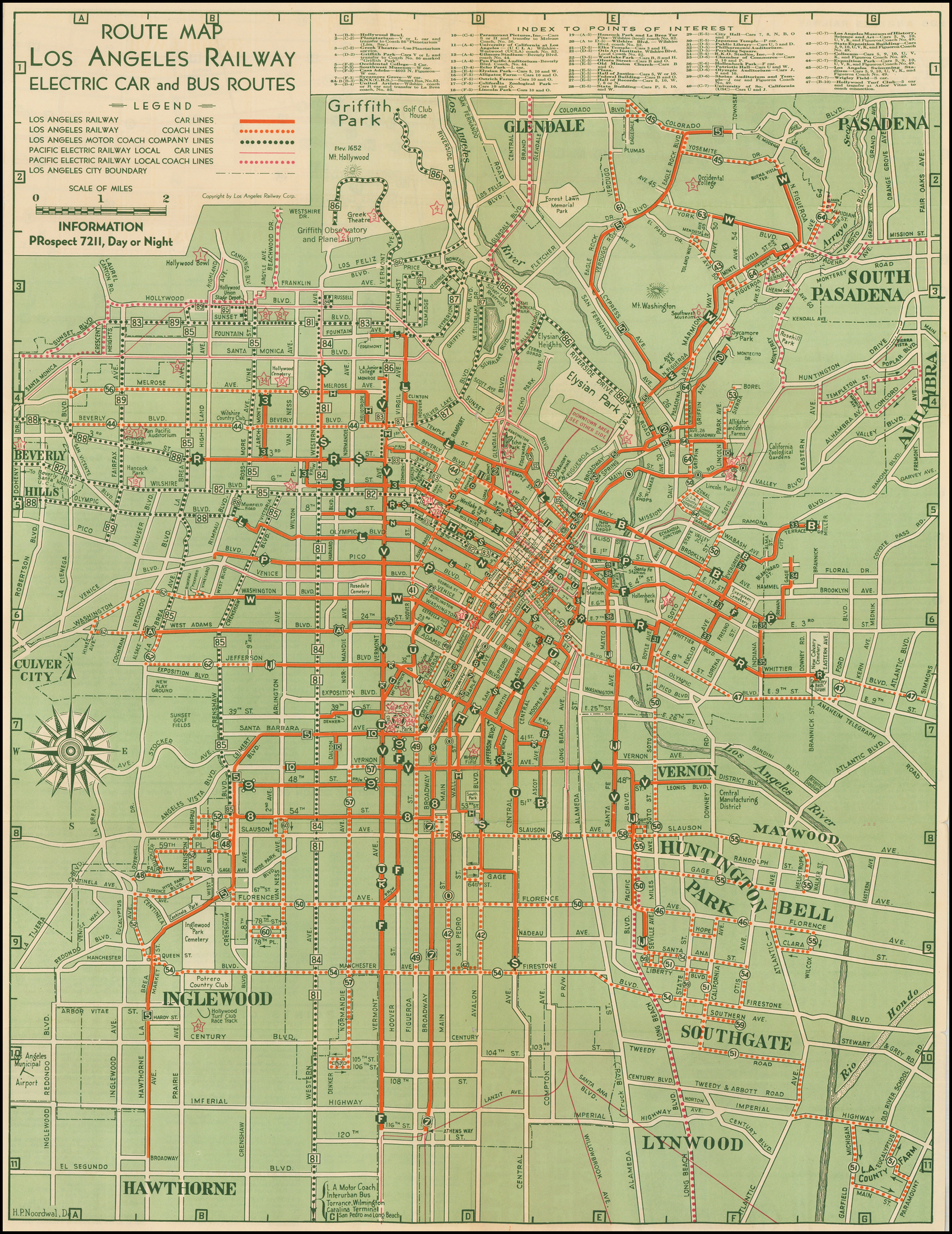
- ^ H.P. Noordwal (1938). "Route Map Los Angeles Railway Electric Car and Bus Routes". Barry Lawrence Ruderman Antique Maps Inc.. Los Angeles Railway. "Alternate link". via Google
- ^ "Timepoints The Southern California Traction Review · Volumes 1-7". Southern California Division, Electric Railroaders' Association. 1950. p. 7.
- ^ "Busses Take Over A Line; Other Changes". The Los Angeles Times. July 1, 1946. p. 13. Retrieved 21 December 2022. – via Newspapers.com.
External links
- A Line Archives — Pacific Electric Railway Historical Society
- "Los Angeles Railway". Electric Railway Historical Association of Southern California