| Minorplanet | yes |
|---|---|
| Background |
|
| Discoverer | E. Bowell |
| Discovery site | Lowell Obs. |
| Discovered | 15 January 1988 |
| Mpc name | (4489) Dracius |
| Alt names | 1988 AK · |
| Adjective | Dracian |
| Named after | Dracius (Greek mythology)[1] |
| Mp category | Jupiter trojan[2][3][4] Greek[5][6] · background[6] |
| Epoch | 23 March 2018 (JD 2458200.5) |
| Uncertainty | 0 |
| Observation arc | 37.94 yr (13,857 d) |
| Aphelion | 5.5196 AU |
| Perihelion | 4.9173 AU |
| Semimajor | 5.2184 AU |
| Eccentricity | 0.0577 |
| Period | 11.92 yr (4,354 d) |
| Mean anomaly | 174.79° |
| Mean motion | / day |
| Inclination | 22.224° |
| Asc node | 86.540° |
| Arg peri | 6.5830° |
| Jupiter moid | 0.1975 AU |
| Tisserand | 2.8480 |
| Mean diameter | 76.60 ± 0.41 km[7] 92.93 ± 7.4 km[8] 95.02 ± 2.47 km[9] |
| Rotation | 12.580 ± 0.001 h[10][a] 12.58 ± 0.1 h[11] 12.582 ± 0.001 h[12][a] 12.582 ± 0.004 h[13] |
| Albedo | 0.050 ± 0.003[9] 0.0514 ± 0.009[8] 0.069 ± 0.005[7] |
| Abs magnitude | 9.00[2][3][4][9] 9.1[7] 9.12 ± 0.22[14] |
4489 Dracius, (prov. designation: ), is a large Jupiter trojan from the Greek camp, approximately 90 kilometers (56 miles) in diameter. It was discovered on 15 January 1988, by American astronomer Edward Bowell at the Anderson Mesa Station of the Lowell Observatory near Flagstaff, Arizona, in the United States.[2] The dark D-type asteroid belongs to the 50 largest Jupiter trojans and has a rotation period of 12.58 hours.[4] It was named after Dracius from Greek mythology, who was a commander of the Epeans who fought against Hector.[1]
Orbit and classification
Dracius is a dark Jovian asteroid orbiting in the leading Greek camp at Jupiter's Lagrangian point, 60° ahead of its orbit in a 1:1 resonance (see Trojans in astronomy). It is a non-family asteroid in the Jovian background population.[6][15] It orbits the Sun at a distance of 4.9–5.5 AU once every 11 years and 11 months (4,354 days; semi-major axis of 5.22 AU). Its orbit has an eccentricity of 0.06 and an inclination of 22° with respect to the ecliptic.[3]
The body's observation arc begins with its first observation as ' at Crimea–Nauchnij in May 1980, almost 8 years prior to its official discovery observation at Anderson Mesa.[2]
Numbering and naming
This minor planet was numbered on 8 June 1990 (M.P.C. 16414).[16] As of 2018, it had not been named.[2] On 14 May 2021, the object was named by the Working Group for Small Bodies Nomenclature (WGSBN), after Dracius from Greek mythology, who was a commander of the Epeans of Elis, who defended the Argive ships from Hector's attack during the Trojan War.[1]
Before Dracius was named, it belonged to a small group of only 8 unnamed minor planets with a designated number smaller than 5000. (All of them are Jupiter trojans or near-Earth asteroids). Since then, several have been named:
- 3708 Socus – named in May 2021
- 4035 Thestor – named in May 2021
- 4489 Dracius – named in May 2021
- 4715 Medesicaste – named in May 2021
- 4835 Asaeus
Physical characteristics
In the SDSS-based taxonomy, as well as in both the Tholen- and SMASS-like taxonomy of the Small Solar System Objects Spectroscopic Survey (S3OS2), Dracius is a dark D-type asteroid.[17][15][18] It has also been characterized as a D-type by Pan-STARRS' survey.[4][14]
On 18 December 2012, Dracius has occulted the star TYC 2467-00054-1 over parts of the United States. The asteroid's brightness was measured at 16.1 and that of the star at 11.1 magnitude.[19]
Rotation period
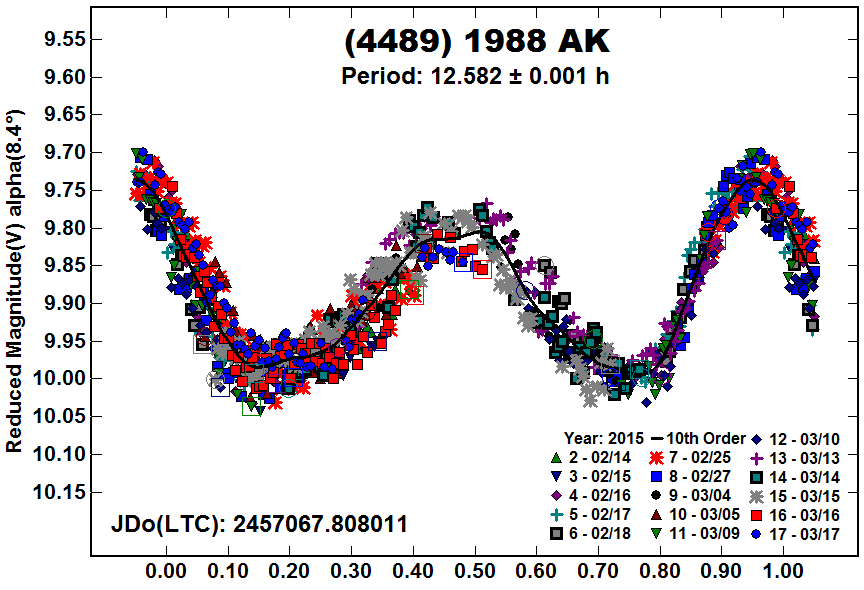
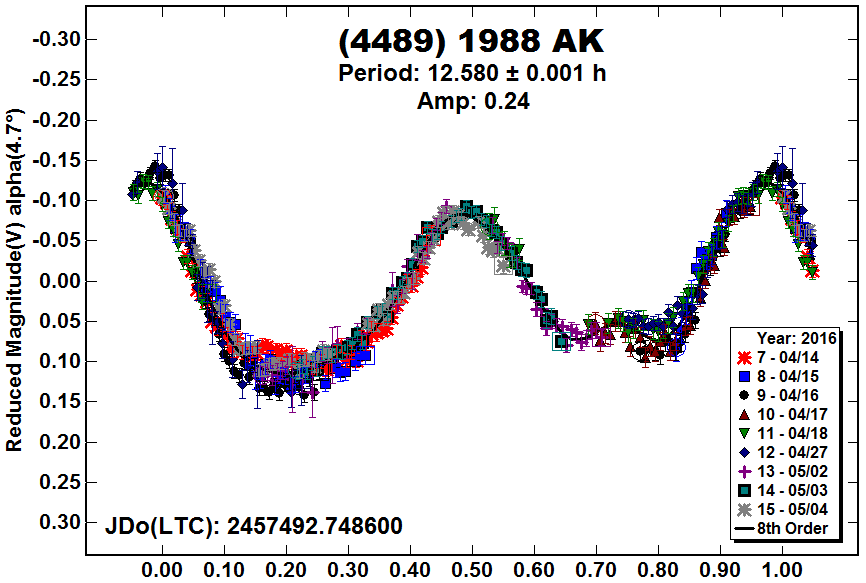
Since 1992, several rotational lightcurves of Dracius have been obtained from photometric observations by Stefano Mottola, as well as Daniel Coley and Robert Stephens at the Center for Solar System Studies, California, in collaboration with Linda French and Brian Warner. Lightcurve analysis gave a well-defined rotation period of 12.582 hours with a consolidated brightness amplitude between 0.20 and 0.26 magnitude (U=3/3).[4][10][11][12][13][a]
Diameter and albedo
According to the surveys carried out by the Japanese Akari satellite, the Infrared Astronomical Satellite IRAS, and the NEOWISE mission of NASA's Wide-field Infrared Survey Explorer, Dracius measures between 76.60 and 95.02 kilometers in diameter and its surface has an albedo between 0.050 and 0.069.[7][8][9]
The Collaborative Asteroid Lightcurve Link adopts the results obtained by IRAS, that is, an albedo of 0.0514 and a diameter of 92.93 kilometers based on an absolute magnitude of 9.0.[4]
Notes
- ^ Lightcurve plots of (4489) 1988 AK (4489 Dracius) from March 2015 and April 2016 by Daniel Coley and Robert Stephens at the Center for Solar System Studies /. Quality code is 3/3 (lightcurve rating at CS3). Summary figures at the LCDB and CS3.
References
- ^ "WGSBN Bulletin Archive". Working Group for Small Bodies Nomenclature. 14 May 2021. Retrieved 16 May 2021. (Bulletin #1)
- ^ "4489 (1988 AK)". Minor Planet Center. Retrieved 7 June 2018.
- ^ "JPL Small-Body Database Browser: 4489 (1988 AK)" (2018-04-25 last obs.). Jet Propulsion Laboratory. Retrieved 7 June 2018.
- ^ No. 4489. Retrieved 7 June 2018.
- ^ "List of Jupiter Trojans". Minor Planet Center. 30 May 2018. Retrieved 7 June 2018.
- ^ "Asteroid (4489) 1988 AK". AstDyS-2, Asteroids – Dynamic Site. Retrieved 7 June 2018.
- ^ Grav, T.; Mainzer, A. K.; Bauer, J. M.; Masiero, J. R.; Nugent, C. R. (November 2012). "WISE/NEOWISE Observations of the Jovian Trojan Population: Taxonomy". The Astrophysical Journal. 759 (1): 10. arXiv:1209.1549. Bibcode:2012ApJ...759...49G. doi:10.1088/0004-637X/759/1/49. S2CID 119101711 (online catalog)
- ^ Tedesco, E. F.; Noah, P. V.; Noah, M.; Price, S. D. (October 2004). "IRAS Minor Planet Survey V6.0". NASA Planetary Data System – IRAS-A-FPA-3-RDR-IMPS-V6.0. 12: IRAS-A-FPA-3-RDR-IMPS-V6.0. Bibcode:2004PDSS...12.....T. Retrieved 15 June 2018.
- ^ Usui, Fumihiko; Kuroda, Daisuke; Müller, Thomas G.; Hasegawa, Sunao; Ishiguro, Masateru; Ootsubo, Takafumi et al. (October 2011). "Asteroid Catalog Using Akari: AKARI/IRC Mid-Infrared Asteroid Survey". Publications of the Astronomical Society of Japan. 63 (5): 1117–1138. Bibcode:2011PASJ...63.1117U. doi:10.1093/pasj/63.5.1117 (online, AcuA catalog p. 153)
- ^ Stephens, Robert D.; Coley, Daniel R.; Warner, Brian D.; French, Linda, M. (October 2016). "Lightcurves of Jovian Trojan Asteroids from the Center for Solar System Studies: L4 Greek Camp and Spies". Minor Planet Bulletin. 43 (4): 323–331. Bibcode:2016MPBu...43..323S. ISSN 1052-8091. Archived from the original on 22 March 2020. Retrieved 19 March 2020.
- ^ French, Linda M.; Stephens, Robert D.; Lederer, Susan M.; Coley, Daniel R.; Rohl, Derrick A. (April 2011). "Preliminary Results from a Study of Trojan Asteroids". Minor Planet Bulletin. 38 (2): 116–120. Bibcode:2011MPBu...38..116F. ISSN 1052-8091. Archived from the original on 20 February 2020. Retrieved 19 March 2020.
- ^ Stephens, Robert D.; Coley, Daniel, R.; French, Linda M. (January 2016). "Large L5 Jovian Trojan Asteroid Lightcurves from the Center for Solar System Studies". Minor Planet Bulletin. 43 (1): 15–22. Bibcode:2016MPBu...43...15S. ISSN 1052-8091. Archived from the original on 3 October 2020. Retrieved 19 March 2020.
- ^ Mottola, Stefano; Di Martino, Mario; Erikson, Anders; Gonano-Beurer, Maria; Carbognani, Albino; Carsenty, Uri et al. (May 2011). "Rotational Properties of Jupiter Trojans. I. Light Curves of 80 Objects". The Astronomical Journal. 141 (5): 32. Bibcode:2011AJ....141..170M. doi:10.1088/0004-6256/141/5/170
- ^ Veres, Peter; Jedicke, Robert; Fitzsimmons, Alan; Denneau, Larry; Granvik, Mikael; Bolin, Bryce et al. (November 2015). "Absolute magnitudes and slope parameters for 250,000 asteroids observed by Pan-STARRS PS1 – Preliminary results". Icarus. 261: 34–47. arXiv:1506.00762. Bibcode:2015Icar..261...34V. doi:10.1016/j.icarus.2015.08.007. S2CID 53493339
- ^ "Asteroid (4489) 1988 AK". Small Bodies Data Ferret. Retrieved 7 June 2018.
- ^ "MPC/MPO/MPS Archive". Minor Planet Center. Retrieved 7 June 2018.
- ^ Carvano, J. M.; Hasselmann, P. H.; Lazzaro, D.; Mothé-Diniz, T. (February 2010). "SDSS-based taxonomic classification and orbital distribution of main belt asteroids". Astronomy and Astrophysics. 510: 12. Bibcode:2010A&A...510A..43C. doi:10.1051/0004-6361/200913322. Retrieved 30 October 2019. (PDS data set)
- ^ Lazzaro, D.; Angeli, C. A.; Carvano, J. M.; Mothé-Diniz, T.; Duffard, R.; Florczak, M. (November 2004). "S3OS2: the visible spectroscopic survey of 820 asteroids". Icarus. 172 (1): 179–220. Bibcode:2004Icar..172..179L. doi:10.1016/j.icarus.2004.06.006. Retrieved 7 June 2017.
- ^ Asteroid Occultation Updates Archived 2012-07-11 at the Wayback Machine
External links
- Lightcurve Database Query (LCDB), at www.minorplanet.info
- Discovery Circumstances: Numbered Minor Planets (1)–(5000) – Minor Planet Center